When Can Babies Regulate Their Own Body Temp
Red Nose does not recommend a specific room temperature for healthy babies.
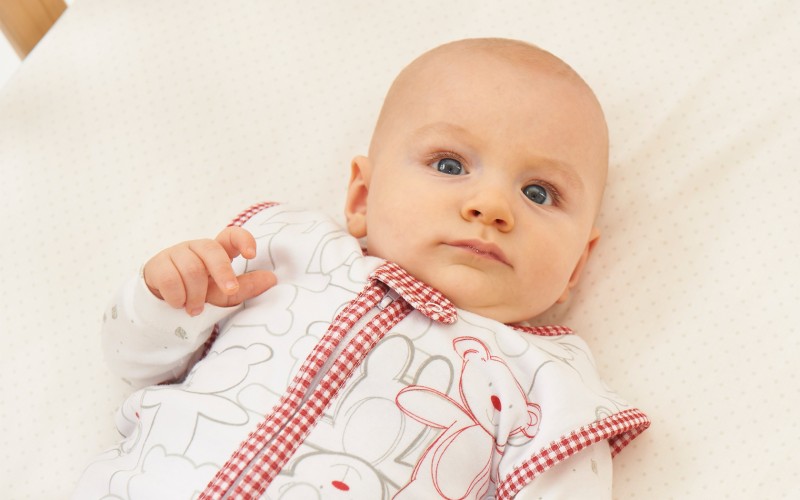
Key Points on Room Temperature
- Babies control their temperature predominantly through the face and head. Sleeping babe on the back with the caput and face uncovered is the best way to protect baby from overheating.
- Information technology is non necessary to monitor the room temperature or to get out the heating or cooling on all nighttime, as long as the baby is dressed accordingly for the room temperature.
- Dress baby as you would wearing apparel yourself – comfortably warm, not hot or cold.
- A expert mode to check infant's temperature is to feel the infant's back or tummy, which should feel warm (don't worry if baby'south hands and feet feel cool, this is normal). If baby is showing signs of heat stress, remove some bedding or clothing. This may be necessary if baby is unwell, in which instance yous should seek medical attention.
- Ensure that baby's head and confront cannot get covered - practice not apply bedding such equally duvets, pillows, bumpers, lambs' wool, or have soft toys in the cot or where the baby is sleeping.
- A good way to avert confront roofing is to apply a rubber babe sleeping bag (1 with fitted neck, armholes or sleeves and no hood).
- If using bedclothes rather than a sleeping purse, it is the all-time to apply layers of lightweight blankets that can exist added or removed easily according to the room temperature and which can be tucked underneath the mattress. The bed should always exist made up and so that the babe is at the foot of the cot to avoid any take chances of the face or head condign covered by bedding.
- Remove infant's bonnet, beanie, hood or hat as shortly as you go indoors or enter a warm motorcar, bus or railroad train, even if it means waking the babe.
- Never utilize electrical blankets, wheat numberless or hot water bottles for babies.
- Never go out infant in a automobile to sleep without supervision.
Thermal stress (overheating) has been implicated in SUDI for many years and avoiding overheating has been one of the strategies to reduce the risk of SUDI.
With the appearance and marketing of nursery thermometers and suggested bedding configurations, parents may retrieve they must maintain a specific room temperature in order to reduce the risk of SUDI. In Australia, it is usually not necessary to measure room temperature.
There is some evidence to testify that very loftier environmental temperatures may increase the risk of SIDS, with a recent report reporting that maximum daily outdoor temperatures greater than 29°C recorded in Canada between 1981 and 2010 were associated with a 3 times greater odds of SIDS compared to 20°C. There was a higher odds ratio in older babies aged three-12 months compared to younger babies aged i-ii months.1 This finding is in contrast to earlier studies which did not find any increased rates of SIDS during a estrus wave in the USA2 or in relation to elevated maximum temperatures in Taiwan.3
With regards to the employ of a fan in the baby's bedroom, a case controlled study of 185 SIDS babies and 312 controls found that the use of a fan was associated with a 72% reduction in SIDS risk.4 The reduction in risk was more pronounced in adverse sleeping environments. For example, when room temperatures were greater than 21°C, there was a 94% decreased hazard of SIDS compared to no fan use. Fan use was as well associated with reduced SIDS take chances at lower room temperatures less than 21°C. The mechanism for this protective effect is unknown, just the authors suggested that fan utilize may reduce rebreathing of exhaled carbon dioxide trapped most a infant'southward airway past bedding.
To date, there is no show to bear witness that maintaining a specific room temperature prevents SUDI and that thermal factors are implicated in SIDS as long equally:
- The baby is placed to sleep on the back
- The baby is dressed accordingly for the room temperature (non over or nether dressed)
- The baby's head and face remain uncovered
Head and Confront Covering
Studies show that the risk of SUDI increases when a baby's face becomes covered by bedding, due east.g. sheets, blankets, quilts and duvets.5-viii In 1996, Fleming and colleagues found that babies who died were more than heavily wrapped than control infants who did not die, with the risk increasing as the tog value (a measure of thermal resistance or insulation) increased. A small merely significant proportion of these babies too wore a hat to slumber. Compared to controls, significantly more babies who died were found at the bottom of the bed, more were institute with covers over their heads, and of these, more were sleeping under duvets.vii
In a review of the 10 papers published on head roofing and SIDS which covered the period betwixt 1958 and 2003, all studies showed an increased adventure for SIDS with a prevalence of head covering among SIDS victims ranging from thirteen% to 48% with a hateful of 25%.9 In control infants who did non die, the prevalence was 0% to 6%, mean 3.2%. The overall increased risk for SIDS was 17-fold – this is 5 times higher than that for prone sleeping and maternal smoking. Parents in four studies reported that over a quarter of SIDS and control infants had previously been found with their heads covered.10
Babies regulate their temperature primarily through their head, particularly their face up. In a heavily wrapped baby, 85% of total heat loss is through the face.eleven If this normal method of estrus loss is restricted by bedding covering the face up, wearing a bonnet, chapeau, hood or beanie or tummy sleeping (partial face roofing by mattress and/or bedding), there is a significantly increased risk for thermal stress to occur.
Tuffnel and colleagues demonstrated that heat loss in breadbasket sleeping babies is 60% less constructive than for non tummy sleeping babies with the same insulation values for clothing and bedding.12 This may explicate why researchers institute that tummy sleeping in combination with increased body insulation increased the gamble of SIDS,13-15 particularly in rooms where the heating was left on.7,15 Hauck and colleagues found that tum sleeping in combination with a soft bedding surface increased the risk of SIDS more than than 20 times.16
The mechanism responsible for death when the face up and caput becomes covered is non entirely articulate. Covering of the face and caput could exist associated with elevated body and brain temperatures. Physiological studies of head covering have shown that, despite only small increases in torso temperature, there are pregnant impairments in the autonomic control of both the respiratory and cardiovascular systems when babies' faces are covered by only a sheet.17 In that location are also more frequent falls in oxygen levels and rebreathing of carbon dioxide when babies' heads are covered.18 It is as well known that babies have depressed arousal from slumber when the confront is covered, even for babies sleeping in the back position.19 Arousal from sleep is an important protective response to life-threatening stimuli and failure to arouse from slumber is thought to exist a possible mechanism leading to SIDS.20
Although testify demonstrates an increased run a risk of SIDS where there is a combination of tummy sleeping, increased thermal insulation and room heating, there appears to be no association betwixt SIDS and high external environmental temperaturestwo as long as the baby is not over insulated and is able to cool down by evaporation of sweat. Sweating is one of the nigh important defenses against overheating and the combination of sweating with scarlet skin may be indicative of overheating.21
Bed-sharing and head covering
Sharing a sleep surface or bed-sharing with a babe can increment the risk of SUDI and fatal sleeping accidents. Studies have suggested that more than than one-half of all SUDI cases occur whilst the infant is sharing a slumber surface.22-29 Some physiological studies take shown that head covering was more common when infants slept in the parental bed compared to when they slept alone in their own cot30 and more than frequent falls in oxygen levels and rebreathing of carbon dioxide occurred.31
Bedding for babies who have a common cold
Inquiry has shown that babies with symptoms of a mutual common cold are often given more bedding than they need due to care giver concerns that babies showing signs of a cold need to be kept very warm.32 In fact, providing assist to babies with a mutual common cold to effectively regulate their temperature is very important. This can be best achieved by placing them on the dorsum to slumber with the head uncovered and removing some bedding or clothing. If baby is overly warm to touch, or showing signs of heat stress (irritability, looking unwell, floppy, drier peel, refusing to drinkable or having fewer moisture nappies than usual) then see your doctor or health professional immediately.
Conclusions
In that location is strong testify to show that tummy sleeping significantly increases the take a chance of SUDI, particularly when the head or face becomes covered. Likewise, there is adept show to evidence that the risk also increases for babies who sleep on their backs if their head or face becomes covered. However, there is no prove to show that actress thermal insulation increases the risk of SIDS in babies who sleep on their back with the head and face uncovered.14 There is too no show to support maintaining a specific room temperature or any specific bedding configurations (number of blankets required) as this depends on a number of factors such as what the infant is wearing, whether it is summer or winter and whether in that location is heating or cooling inside the room where the baby is sleeping.
The Scarlet Nose Condom Sleeping plan is based on scientific testify and was developed by Australian SUDI researchers, paediatricians, pathologists, and child health experts with input from overseas experts in the field. The 85% drib in SIDS deaths and the 9,967 lives that take been saved is attestation to the effectiveness of the programme.
For farther information phone Red Olfactory organ in your State or Territory on 1300 998 698.
Suggested commendation:
Cherry-red Olfactory organ. National Scientific Advisory Group (NSAG) 2016. Information Argument: Room temperature. Melbourne, Red Olfactory organ. This information statement was first posted in September, 2007 and updated in Baronial 2016.
View the references for this commodity here.
Last modified: 27/ii/18
olivareswashe1945.blogspot.com
Source: https://rednose.org.au/article/room-temperature
0 Response to "When Can Babies Regulate Their Own Body Temp"
Postar um comentário