what is the most significant event to take place in the united states since 1865?

By Claudia Deane, Maeve Duggan and Rich Morin
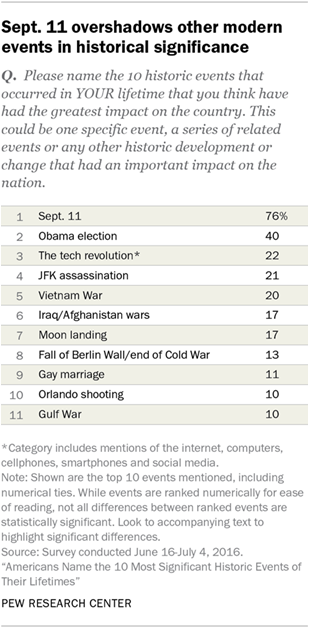
Shared experiences define what it means to be an American. The Sept. 11, 2001, terrorist attacks were such a unifying outcome for modern Americans. Nothing else has come close to being every bit important or every bit memorable, according to a new survey conducted by Pew Research Center in association with A+Eastward Networks' HISTORY.
Roughly three-quarters (76%) of the public include the Sept. 11 terror attacks as one of the ten events during their lifetime with the greatest impact on the land, co-ordinate to a national online survey of two,025 adults conducted June xvi-July iv, 2016.
The perceived historic importance of the attacks on New York and the Pentagon, span virtually every traditional demographic divide. Majorities of men and women, Millennials and Baby Boomers, Americans with college degrees and those without a loftier school diploma rate 9/11 every bit 1 of the 10 nigh historically significant events to occur during their lifetime. And while they seem to concur on little else this ballot yr, the survey finds that more than than vii-in-ten Republicans and Democrats name the attacks as one of their top 10 historic events.
The one exception to this pattern is the views of blacks and whites. While the Sept. 11 attacks easily top the list for whites, it shares the top spot with the election of President Barack Obama amidst blacks. Similarly, the civil rights move ranks behind only the election of Obama and 9/xi on the list of well-nigh pregnant events for blacks but is absent from the tiptop 10 lifetime events for whites.
Only as striking as the public's consensus on the impact of nine/11 is the steep drop-off in the proportion of Americans who name other notable events. The election of Obama is the 2nd-most frequently named event, listed by 40% of the public. Every other issue is named by fewer than one-quarter of all adults. This includes the changes ushered in by the internet, personal computers, smartphones and other innovations of the tech revolution, the assassination of John F. Kennedy, and the Vietnam State of war.
To measure how Americans view the importance of recent celebrated events, Pew Inquiry Center conducted a national, probability-based survey with a representative sample of adults who are members of the GfK KnowledgePanel, a national, probability-based online panel. Pew Enquiry Center received supplemental funding from HISTORY to behave this survey.
Survey participants were asked to list the x historic events that occurred during their lifetimes that they thought "have had the greatest impact on the country." Respondents were farther told that they could proper noun a specific event, a serial of related events or whatever other celebrated evolution that had a major influence on American life.
The survey finds that Americans are primarily bound together past their generation and the major events that occurred during their formative years. For the oldest Americans, the Silent and Greatest generations, that unifying event is Earth War Two. For Babe Boomers, the assassination of John F. Kennedy and the Vietnam War are defining moments. For Millennials and Gen Xers, the ix/11 terror attacks and the Obama election leads the list by a greater margin than for other generations.
The top 10 list for these young Americans too varies from the rankings of other generations. For example, the Columbine school shooting makes the acme 10 listing of Millennials and Gen Xers but not Boomers or the Silent Generation. Millennials besides are unique in that five of their top 10 events – the Sandy Claw and Orlando/Pulse nightclub shootings, the death of Osama bin Laden, the Boston Marathon bombing and the Great Recession – announced in no other generation'due south top 10 list.
The public'southward responses to ii other survey questions are even more than varied. When asked to proper name the historic consequence that made them feel the proudest of their country, the country's collective response to Sept. 11 led the list, although it is just named by 19% of adults. The Obama ballot finishes a afar 2nd with 14%, while the moon landing, the killing of bin Laden and the legalization of gay wedlock receive single-digit support.
At the aforementioned time, the Obama presidency and the presidential campaign of Republican Donald Trump top the rankings of events that most disappoint the state (about i in 10 named each), views that are clearly associated with the partisan leanings of respondents.
The remainder of this report explores these results in more than item. The first sections report the similarities and differences in the rankings by generation, race and ethnicity, gender, income, pedagogy, political party and region of the state. The post-obit sections examine events Americans consider the well-nigh significant to the country and to them personally, and which occurrence makes them the proudest and most disappointed in their country.
Generations experience recent history through the lens of their lifetimes
How to translate the generational data
Since the survey question asks respondents to proper noun events that occurred during their lifetimes, a number of these results are highly age-specific and should be interpreted in that light. Younger adults – Millennials and Gen Xers – have experienced fewer historic events only because they take not lived as long equally Baby Boomers or members of the Silent Generation. In other words, the fact that younger Americans don't listing World War Ii doesn't mean they believe the Second World War is non a historically of import event, it just means it was not an effect that occurred in their lifetime.
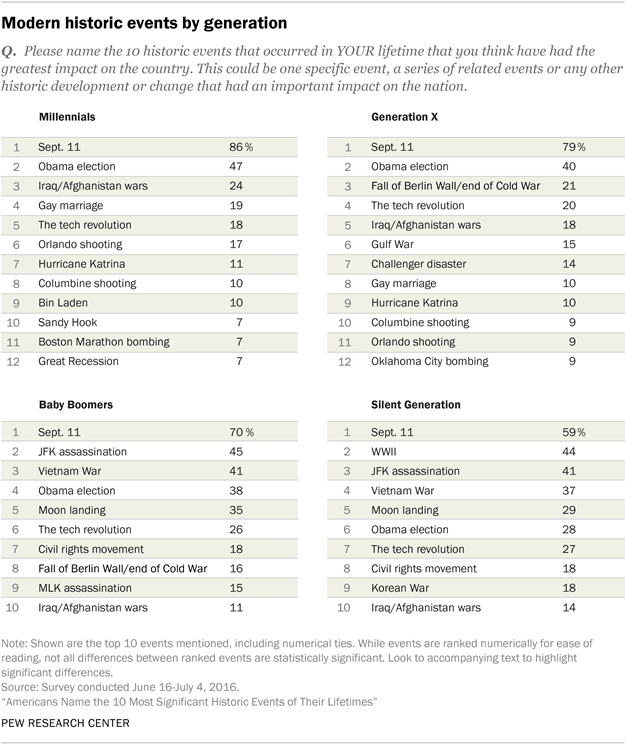
Similar people, generations have distinctive identities that are linked, in part, to singular events that occurred during their members' formative years. For the oldest Americans, the Silent and Greatest generations,1 that unifying effect is World War 2. These men and women proper noun the Second World State of war (44%) near the top of their list of of import events, behind just 9/eleven (59%).
Similarly, the assassination of John F. Kennedy, the Vietnam State of war and the Apollo 11 moon landing stand out on Baby Boomers' list of major celebrated events that occurred in their lifetimes. Fully 45% of Boomers listing the Kennedy assassination as one of their elevation 10 events, while most as many (41%) proper name the Vietnam War and near a third (35%) name the moon landing (events that too appear on the Silent Generation'southward top 10 list).

While much of the historic tape remains largely to be written for the Millennials and Generation X, two singular historic events already stand out at the top of their lists: Sept. 11 and the election of Barack Obama, the first blackness president. These younger generations are unique in the high level of consensus of their rankings. Fully 86% of Millennials list 9/eleven equally a pregnant event in their lifetimes and 47% name the Obama presidency. As well, 79% of Gen Xers name Sept. 11 at the top of their list, while forty% list Obama'southward ballot. Among older generations, a larger selection of historic events garners mention by more than than a quarter of their members.
The generations differ primarily in the relative importance they place on Sept. eleven compared with the Obama presidency. The Sept. xi terrorist attacks are the single about frequently mentioned historic event beyond all generations. However, the proportions of each generation who share this view differ significantly.
For example, nearly 9-in-ten Millennials (86%) name the terror attacks as an important historic issue, compared with 59% of those in the Silent Generation or older.
Obama'southward ballot and presidency finishes as the second-most frequently named historic issue amongst Millennials and Gen Xers (47% and 40%, respectively). By contrast, among members of the Silent Generation, Obama's ballot (28%) finishes well behind three other celebrated events: 9/11 (59%), World War 2 (44%) and the bump-off of John F. Kennedy (41%).
Millennials take entered into the stream of history relatively recently, and as a issue a number of modern events stand out more to them than to their counterparts in other generations. The wars in Iraq and Afghanistan make the acme x listing of Millennials (24%) and Gen Xers (eighteen%) but barely make the top rankings of Babe Boomers (xi%). The U.South. Supreme Court determination legalizing gay union makes the superlative 10 list of Millennials (19%) simply is mentioned significantly less often by Gen Xers (10%), Baby Boomers (7%) and members of the Silent Generation (iii%). And the Orlando shooting ranks every bit one of the top historic events that accept occurred in the lives of Millennials (17%, compared with 9% of Gen Xers, 7% of Boomers and vi% of Silents).
Millennials are likewise unique in that five of their top 10 events announced in no other generation'south tiptop 10: the Killing of Osama bin Laden (10%), the Sandy Claw school shootings (7%), the Boston Marathon bombing (seven%) and the Great Recession (7%). In addition, the Gulf State of war and the Challenger disaster are just named by Gen X (xv% and fourteen%, respectively), while the Martin Luther Rex Jr. assassination (15%) appears on only 1 generation'due south list – Baby Boomers.
To some extent, these findings are predictable: Young Americans simply take not lived long enough to have experienced the same number of history-making events of older adults. Conversely, some events like World War 2 could only be experienced by one generation, and other events like the Korean War occurred during another generation's formative years.
Only four events appear on the tiptop 10 lists of all four generations: Sept. 11, the Obama election, the wars in Republic of iraq/Afghanistan and the tech revolution.
For blacks, Obama presidency ranks with 9/11 every bit virtually meaning event
Blacks and whites view recent history differently in several key means, beginning at the very summit of the rankings: Blacks are the only demographic grouping in which any other historic result challenges the prominence of Sept. 11 in importance. Specifically, among blacks, every bit many people (roughly six-in-ten) named Barack Obama'south election as one of the tiptop ten celebrated events of their lifetime equally named Sept. 11. Among whites, Obama'southward election ranks a afar 2d (36%) compared with the 80% who name Sept. 11.
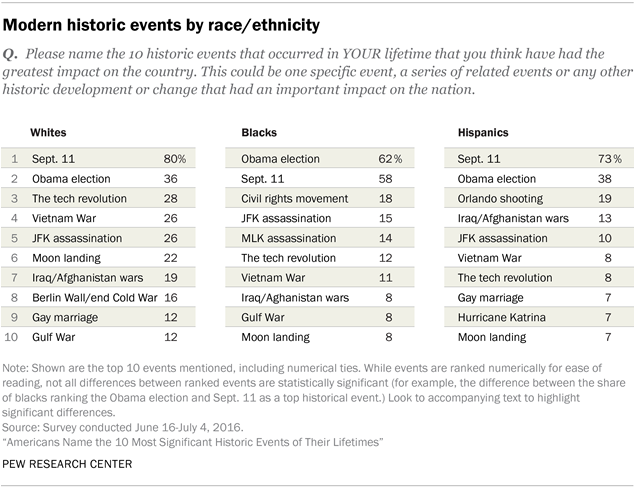
Not surprisingly, events related to the black struggle for equal rights also accept particular relevance to black Americans, though far less then for whites. Amidst blacks, eighteen% say the civil rights move 2 is one of the 10 most meaning events to occur during their lifetimes. By dissimilarity, only eight% of whites cite the ceremonious rights motion – and it fails to make their top x events list.
Even though the fight for black equality continues today, the ceremonious rights movement is more salient to blacks who lived during the 1960s, when many of the seminal events of the movement occurred. Amid blacks ages 45 and older, roughly a tertiary (32%) rate the struggle for equal rights as a touchstone event in their lives.
Eight of the 10 events on the top ten lists of blacks and whites are the same. Beyond nine/xi and the Obama election, the top 10 lists of blacks and whites include the assassination of John F. Kennedy, the tech revolution, Vietnam, Iraq/Afghanistan wars, the Gulf War and the moon landing.
On six of the eight events that appeared on both lists, significantly smaller proportions of blacks view the event equally impactful compared with whites. For example, the tech revolution appears on both top 10 lists and is cited by 28% of whites simply but 12% of blacks. Similarly, the Vietnam War is cited by 26% of whites merely 11% of blacks.
Much like the civil rights motility, the historical significance of the Martin Luther Male monarch Jr. assassination is perceived differently by blacks and whites. Some 14% of black respondents name the civil rights leader'south assassination, compared with but 7% of whites. Further, while the MLK assassination ranks fifth for blacks, it fails to make the elevation 10 listing of celebrated events for whites.
Meanwhile, the Orlando/Pulse nightclub shooting ranks relatively high amidst Hispanics (mentioned by 19%). Past contrast, ix% of whites and 7% of blacks say this mass shooting is equally momentous. While these data cannot explicate why Latinos disproportionately run into the Orlando/Pulse mass shooting as historically significant, the circumstances of the attack provide some clues. The attack occurred on the night that Pulse, a popular nightclub, was hosting a "Latin Dark" celebration, and counts immediately after the tragedy bespeak that ninety% of the 49 murder victims were Latino. Also, the shooting victims were predominantly immature, and Hispanics as a group are disproportionately young relative to the white and black populations.
Republicans, Democrats accept more similarities than differences
The events in American history named by Republicans and Democrats overlap essentially, and differences between the two parties are primarily a matter of degree. Large majorities of both Republicans (80%) and Democrats (74%) name Sept. 11 as a significant outcome in their lifetimes. While both parties name the election of Obama equally president the 2nd-most often, Democrats are somewhat more likely than Republicans to cite this consequence (46% vs. 33%).

No real gender gap in views of historic events
When it comes to evaluating recent American history, the new survey data propose there is trivial to no gender gap in the manner men and women rank the events that shape their times. Every bit is true across generations, Sept. xi stands out past far as the most impactful event among both men and women, with Obama's election post-obit as a afar 2d. Other events are clustered in roughly like patterns amongst both sexes, and include the tech revolution, the Vietnam War and the moon landing. These events are named past between fifteen% and 25% of both male and female person respondents.
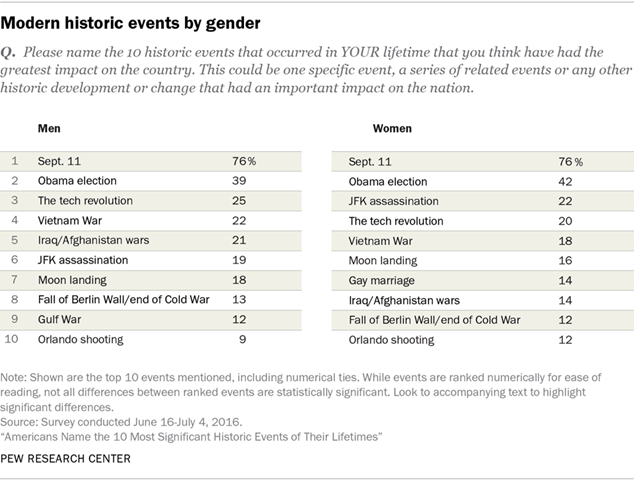
In terms of differences, the recent wars in Iraq and Afghanistan rank higher among men (5th, at 21%) than among women (eighth at 14%). The Gulf State of war that took place during the George H.W. Bush-league assistants is named by 12% of men and 8% of women. Women are slightly more probable to proper name gay union (fourteen% do, compared with 8% of men).
Beyond regions, 9/eleven tops the list

Americans living in diverse parts of the U.Due south. think remarkably akin nearly the historic events that have had the greatest impact on the land. Sept. eleven tops each regional list by a large margin, from the attacks' geographical centers of New York Metropolis and outside Washington, D.C., to the W Coast. Fully eighty% in the Northeast proper name the terrorist attacks, every bit do 77% of those in the Midwest, 75% in the West and 74% in the South.
As has been truthful across various demographic breaks, the election of Barack Obama equally commander in primary ranks a articulate merely distant second.
The differences from in that location are express and subtle; in fact, the percentages for a given event rarely differ between regions by more than v points.
Tech plays somewhat differently across education, income

Across education and income levels, Americans are consequent in the events they name as historic, with a few notable variations. Every bit is true across many other demographic breaks, Sept. xi tops the list of responses in each teaching level by a wide margin, followed by the ballot of President Barack Obama.
While the tech revolution makes the top 10 list of respondents in each education level, those with at to the lowest degree some college experience are more likely to cite these advancements than those with a high school diploma or less. A third of those with a college degree and 23% of those with some higher experience name the tech revolution, compared with 14% of those with a high school diploma or less. The same blueprint occurs beyond income groups.
Little consensus on proudest or near disappointing moments

Americans were also invited to counterbalance in on the times and events that made them well-nigh proud of their land, and those that left them feeling most disappointed. Perhaps the most significant finding is that there is much less agreement on this forepart than when it comes to naming events that are historically of import, in that no i reply is named by more a quarter of the public.
To the extent that Americans coalesce upon a point of pride, it is the nation'due south response to 9/11, including mentions of the bravery of first responders, the outpouring of genuine sympathy for victims or the mode the land united after the terrorist attacks. Overall, 19% cite this as the moment they felt near proud of America.
The election of Barack Obama ranks second, named past 14% as i of the country's finest moments. Yet nearly every bit large a share of the public (xi%) meet his election or presidency as their biggest disappointment. Correct there with Obama at the top of the disappointments list is the Republican main election campaign that led to the nomination of Donald Trump, cited by x% of respondents (note, the survey was fielded in the summer of 2016).
In that location are key differences by race and by party identification in some of these responses. Fully 45% of black Americans say they were proudest of their state after Obama'southward election, more than five times the share of whites (viii%) and more than triple the proportion of Hispanics (12%) who share that view. Democrats are also significantly more likely than Republicans to cite Obama'south election as their proudest moment (23% vs. three%), a departure simply partially explained by the unduly large share of blacks who identify with the Democratic Party.
Meanwhile, Republicans (32%) are significantly more probable than Democrats (17%) to say the response to 9/11 is the time in their lives when they felt the proudest of the country. And a significantly larger share of Republicans (23%) than Democrats (2%) rate Obama'southward election and presidency as the about disappointing event in their lifetimes.
olivareswashe1945.blogspot.com
Source: https://www.pewresearch.org/politics/2016/12/15/americans-name-the-10-most-significant-historic-events-of-their-lifetimes/
0 Response to "what is the most significant event to take place in the united states since 1865?"
Postar um comentário